The concept of “I” seems to be on a permanent run.
To a naive mind „I” (self) is a very simple concept. I am one and indivisible.
But philosophers noted that it can never be fully observed. At least three problems have been noted.
1) If want to reflect upon my mind, I can probably do so. But in this case the observer is also an “I”. If I want to observe this second I, I become the third I (no pun intended), then the fourth and the fifth I, etc. Philosophers call this an infinite regress. Anyway, I will never see the entire I, because I will need some I to be the observer.
Quotation:
According to the legend, whenever an agent does anything intelligently, his act is preceded and steered by another internal act of considering a regulative proposition appropriate to his practical problem. [...] Must we then say that for the hero's reflections how to act to be intelligent he must first reflect how best to reflect how to act? The endlessness of this implied regress shows that the application of the criterion of appropriateness does not entail the occurrence of a process of considering this criterion.(The Concept of Mind (1949), p. 31.)
2) What does it mean to reflect upon my mind, to introspect? Does it mean to observe one’s mind as it looks now? Or does it mean to observe one’s mind as it was some moments ago? Some people think that introspection is retrospection. When I am angry and also think about my anger, I probably remember my anger some moments ago. And what about the person some moment ago? Is it still I? Or perhaps it is a he?
Quotation:
There is one last objection to be made against the claim for introspection, that made by Hume. There are some states of mind which cannot be coolly scrutinised, since the fact that we are in those states involves that we are not cool, or the fact that we are cool involves that we are not in those states. No one could introspectively scrutinise the state of panic or fury, since the dispassionateness exercised in the scientific observation is, by the definition of panic and fury, not the state of mind of the victim of those turbulences. Similarly, since a convulsion of merriment is not the state of mind of a sober experimentalist, the enjoyment of a joke is also not an introspectible happening. States of mind such as these more or less violent agitations can be examined only in retrospect. Yet nothing disastrous follows from this restriction. We are not shorter of information about panic or amusement than about other states of mind. If retrospection can give us data we need for our knowledge of some states of mind, there is no reason why it should not do so for all. And this is just what seems to be suggested by the popular phrase to catch oneself doing so and so.
Gilbert Ryle The Concept of Mind p. 166, Google Books
3) Some philosophers say that you can observe only your particular experience: pain, pleasure, hatred, but never something like I
Quotation:
For my part, when I enter most intimately into what I call myself, I always stumble on some particular perception or other, of heat or cold, light or shade, love or hatred, pain or pleasure. I never can catch myself at any time without a perception, and never can observe any thing but the perception.
Hume http://www.mnstate.edu/gracyk/courses/web%20publishing/TreatiseI.iv.vi.htm
Showing posts with label philosophy of mind. Show all posts
Showing posts with label philosophy of mind. Show all posts
Friday, 1 July 2011


Sunday, 7 November 2010
Quotes Without Context

„there are certain features of the bodily sensations especially, but also of certain peceptual experiences, which no amount of purely physical information includes. Tell me everything about physical there is to tell about what is going on in a living brain, their relation to what goes on at other times and in other brains, and so on and so forth, and be I as clever in fitting it all together, you won’t have told me about the hurtfulness of pains, the itchiness of itches, pangs of jealousy, and about the characteristic experience of tasting a lemon, smelling a rose, hearing a loud noise or seeing the sky.”
Frank Jackson
Epiphenomenal Qualia
In David J. Chalmers (ed.) Philosophy of Mind
Classical and contemporary readings (page 273)
„Suppose we tried to say that the redness or blueness of light was nothing but a specific wavelength of EM waves. Well, if we tried such an ontological reduction, the essential features of the light would be left out. No description of the extrinsic wavelenghts of EM waves could possibly convey the intrinsic character of (objective) visible redness and visible blueness for the simple reason that visible properties of light are distinct from the physical properties of EM waves. This argument is ludicrously simple and quite decisive.”
Paul M. Churchland
The Rediscovery of Light
In David J. Chalmers (ed.) Philosophy of Mind
Classical and contemporary readings (page 363)
Monday, 18 October 2010
Mass production of my beautiful self

Can brains be copied? Or more precisely, will we be able in some distant future to make copies of the information contained in our heads for some future use. I am sure top secret scientists are working on it and one day we will learn that the illuminating papers written on philosophy of mind were for some scholars only a front for some substantial undercover operation paid for by the military (mind uploading, whole brain emulation, mind transfer).
But we must not expect that one day we will be able to pack in our mindes and wake up in a different, possibly more superior bodies. Subjectivity cannot be copied, now or in the future, I think. Just imagine what happens if they make 100 copies of me. I would have to wake up in 100 bodies, if they put me into all of them. I would have to listen to a cacophony of thoughts, from different selves, less and reminding me and going their separate ways. Or if I wake up in one body, while should be this particular one, and no other. How to keep just one loudspeaker on, and turn off the remaining ones.
I better remain mortal.
Dualist without God.
Monday, 16 August 2010
Must be absurd to be true

Tertulian
(reputedly said "credo, quia absurdum" - I believe, because its absurd)
Many people, including myself are dualists, because they think it quite obvious that we have minds, thoughts and feelings and, moreover, private access to them. Private access means that I do not need to look into my brain or a brain scanner in order to know that I suffer. But there are those who argue that science is not about highlighting things which are evident.
On the contrary, it sometimes takes things which on first appearances are completely absurd, but after experiments they turn out quite well justified, presumably even true. Science seems to be Tertulianesque in this regard.
The Copernican revolution or Einstein’s claim that time is relative provide good examples of science’s changing things which are absurd into quite reasonable.
We main think materialism absurd, but so was the centrality of the Sun in the Solar system.
Some philosophers even think that dualist psychology shall one day be replaced with neuroscience and treated as folk psychology. We may simply be wrong in saying that we have thoughts and feelings.
I like this argument against dualism. But I do not think a case has been fully made for it. That sometimes science takes us by surprise is a fact, but it does not mean it will in every instance. Claiming so would be equivalent to very radical scepticism, or perhaps complete scepticism. Actually, it would mean that every proposition in which we believe is untrue and only waiting to be replaced by science. The sceptics of old may have deconstructed our whole world but stopped short of denying us our self (or selves). The twentieth century was not so timid, in the form of Freudianism and Analytic Philosophy, but abolishing an even imperfect self paves a road to madness, I think.
And finally, our phenomenology, our introspection provides us with data not theory. Such raw data we may wish to explain as quite a puzzling phenomenon, or cut aside with an Occam’s razor, if only for their notorious non-objectivity, privacy. But what we do not get from such self-examination is theory, which would explain something and compete with other theories, like neuroscience, for the same set of data. Our thoughts and feelings are raw data which may or may not need a theory to explain them. Maybe a little less reliable than we once thought, but data nevertheless.
Sunday, 14 March 2010
Mind, God and immortality
On my Polish blog I wrote about the difference between the old philosophising about the soul and modern mind/body problem. The concept of the soul appears in inquiries about human immortality, while the concept of more or less non-material mind is to explain an equally puzzling miracle of private access to our minds, introspection, etc. Our minds need not be immortal, while the concept of soul more often than not implies immortality. While we have direct access to our minds, Cicero thinks that we do not have direct access to our souls. We can learn about them indirectly, the same as we learn about God.
That our inquiries about the human mind bear few consequences for the issue of our immortality is shown by the following quotation from Hume. Hume starts with the panpsychism of the stoics (which nowadays seems to be restored by David Chalmers, who thinks that consciousness is more dispersed in the world than usually expected).
“…admitting a spiritual substance to be dispersed throughout the universe, like ethereal fire or the Stoics and to be the only inherent subject of the thought, we have reason to conclude from analogy that nature uses it after the manner she does the other substance, matter. She employs it as a kind or paste or clay; modifies it into a variety of forms and existences; dissolves after a time each modification and from its substance erects a new form. As the same material substance may successively compose the bodies of all animals, the same spiritual substance may compose their minds. Their consciousness or the system of thought, which they form during life, may be continually dissolved by death. And nothing interests them in the new modification. The most positive asserters of mortality of the soul never denied the immortality of its substance. And that an immaterial substance, as well as material may lose its memory or consciousness appears, in part, from experience, if the soul be immaterial”.
David Hume Of the Immortality of the Soul (page one or two)
Let me put very simply: you do not need to believe in God or immortality to be a dualist.
That our inquiries about the human mind bear few consequences for the issue of our immortality is shown by the following quotation from Hume. Hume starts with the panpsychism of the stoics (which nowadays seems to be restored by David Chalmers, who thinks that consciousness is more dispersed in the world than usually expected).
“…admitting a spiritual substance to be dispersed throughout the universe, like ethereal fire or the Stoics and to be the only inherent subject of the thought, we have reason to conclude from analogy that nature uses it after the manner she does the other substance, matter. She employs it as a kind or paste or clay; modifies it into a variety of forms and existences; dissolves after a time each modification and from its substance erects a new form. As the same material substance may successively compose the bodies of all animals, the same spiritual substance may compose their minds. Their consciousness or the system of thought, which they form during life, may be continually dissolved by death. And nothing interests them in the new modification. The most positive asserters of mortality of the soul never denied the immortality of its substance. And that an immaterial substance, as well as material may lose its memory or consciousness appears, in part, from experience, if the soul be immaterial”.
David Hume Of the Immortality of the Soul (page one or two)
Let me put very simply: you do not need to believe in God or immortality to be a dualist.
Wednesday, 18 November 2009
Farewell to Semantics (part two)
So when are words replaceable in sentences starting with "I believe"?
Not when they denote the same thing, as shown by many examples of the "Morning Star/Evening Star" type. Not even when they have the same meaning, because the speaker (believer) many not know that they have the same meaning.
I suggest that replaceablity of words in intensional contexts must always taken relative to the subject of the sentence (= believer). The relevant relation would look more less like this"
(1) aD(B)a = a has for B the same denotation as b
where a and b are names such "Morning Star" and "Evening Star" respectively, "Rome" and "capital of Italy" respectively, "Cicero" and "Tully" respectively or "Superman" and "Clark Kent respectively. Let me suggest the following definition
(2) a is replaceable by b in sentences about B believing something iff aD(B)a
(this should be properly formalised, but I am now only testing my intuitions)
This definitely explains why the sentences
(3) Marek believes that Rome is a beautiful city
(4) Marek believes that the capital of twentieth century Italy is a beautiful city
are both true
but not sentences
(5) Cicero believes that Rome is a beautiful city (true perhaps)
(6) Cicero believes that the capital of twentieth century Italy is a beautiful city (false or nonsensical)
Simply, the two relevant descriptions have the same denotations for Marek but not for Cicero
There are four things to be said about this account of belief sentences. Two not so good and two quite good.
Not so good
(A) This solution is a capitulation. D(B) is not a general relation of meaning. It is not about meaning in a language. It is relativised to a particular believer. So it is not very general. So it may not be very interesting.
(B) You must be very careful how you formulate even informal paraphrases of D(B). For instance, you cannot say that aD(B)b means that B believes that "a" has the same denotation is "b". This would smack of a vicious circle, but this may not be the biggest problem. The problem is that the using of "believe" in the definition of aD(B)b could invite the same paradoxes as those which we tried to explain in the first place. Wherever we have belief we have intensionality
The solution is that "a has for B the same denotation as b" would be explained in behavioristic terms which would not include "believe". This is the philosophy of mind bit. I am very unwilling to recourse to behaviorism, because I like mental concepts and do not want to explain them away, but what can I do? I am just forced to accept it in this case, to explain the semantic puzzle.
Good
(C) This is a very simple solution at first glance (but complications lurk)
(D) It seems to save compositional semantics, although a reference is made to metalanguage, on both side of truth conditions. The intuitive sketch would look as follows.
The sentence "John believes Rome is a beautiful city" iff John believes Rome is a beautiful city and "Rome" denotes Rome for John
If it looks again like a vicious circle, but let me remind that the explication of "Rome" denotes for John Rome would be behaviouristic and "Rome" could be treated as a physical sound and denotation of Rome by "Rome" for John perhaps some physical disposition or co-occurance.
Am I satisfied with this solution? I will need to look at it again later
Not when they denote the same thing, as shown by many examples of the "Morning Star/Evening Star" type. Not even when they have the same meaning, because the speaker (believer) many not know that they have the same meaning.
I suggest that replaceablity of words in intensional contexts must always taken relative to the subject of the sentence (= believer). The relevant relation would look more less like this"
(1) aD(B)a = a has for B the same denotation as b
where a and b are names such "Morning Star" and "Evening Star" respectively, "Rome" and "capital of Italy" respectively, "Cicero" and "Tully" respectively or "Superman" and "Clark Kent respectively. Let me suggest the following definition
(2) a is replaceable by b in sentences about B believing something iff aD(B)a
(this should be properly formalised, but I am now only testing my intuitions)
This definitely explains why the sentences
(3) Marek believes that Rome is a beautiful city
(4) Marek believes that the capital of twentieth century Italy is a beautiful city
are both true
but not sentences
(5) Cicero believes that Rome is a beautiful city (true perhaps)
(6) Cicero believes that the capital of twentieth century Italy is a beautiful city (false or nonsensical)
Simply, the two relevant descriptions have the same denotations for Marek but not for Cicero
There are four things to be said about this account of belief sentences. Two not so good and two quite good.
Not so good
(A) This solution is a capitulation. D(B) is not a general relation of meaning. It is not about meaning in a language. It is relativised to a particular believer. So it is not very general. So it may not be very interesting.
(B) You must be very careful how you formulate even informal paraphrases of D(B). For instance, you cannot say that aD(B)b means that B believes that "a" has the same denotation is "b". This would smack of a vicious circle, but this may not be the biggest problem. The problem is that the using of "believe" in the definition of aD(B)b could invite the same paradoxes as those which we tried to explain in the first place. Wherever we have belief we have intensionality
The solution is that "a has for B the same denotation as b" would be explained in behavioristic terms which would not include "believe". This is the philosophy of mind bit. I am very unwilling to recourse to behaviorism, because I like mental concepts and do not want to explain them away, but what can I do? I am just forced to accept it in this case, to explain the semantic puzzle.
Good
(C) This is a very simple solution at first glance (but complications lurk)
(D) It seems to save compositional semantics, although a reference is made to metalanguage, on both side of truth conditions. The intuitive sketch would look as follows.
The sentence "John believes Rome is a beautiful city" iff John believes Rome is a beautiful city and "Rome" denotes Rome for John
If it looks again like a vicious circle, but let me remind that the explication of "Rome" denotes for John Rome would be behaviouristic and "Rome" could be treated as a physical sound and denotation of Rome by "Rome" for John perhaps some physical disposition or co-occurance.
Am I satisfied with this solution? I will need to look at it again later
Sunday, 15 November 2009
Farewell to Semantics (part one)
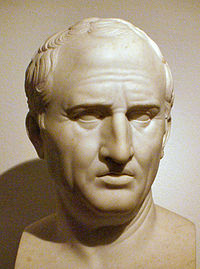
Some entries earlier I described the old and famous intensionality paradox my philosophy teachers were fascinated about. (do not forget to click)
Here is another example:
(1) Cicero believed that Rome was a great town
But Rome is also the capital of Italy, so Rome and the capital of Italy are the same thing.
(2) Rome = capital of Italy,
so by way of substitution, the following should be true
(3) Cicero believed that the capital of Italy was a great town.
But this is false. Cicero did not have the faintest idea about Italy, not in the modern sense, and what its capital was.
Why is this paradox disquieting? This is connected with three names
1’) Frege and compositional semantics
2’) Tarski and definition of truth
3’) Davidson and truth-conditional theory of meaning
Re 1') The compositionality principle says that the meaning of a complex expression is determined by the meanings of its constituent expressions and the rules used to combine them. In particular, it depends on what entities are assigned to constituent words. The town of Rome is assigned to the word “Rome”. But the meaning of (1') and (3') does not depend only on the reference of words, but also what words are actually used (“Rome” or “capital of Italy”). And this seems to be unpredicable.
Re 2') This is similar. Once you assign meaning to basic proper names, variables and predicates (or put more simply to basic constituents of language), you can determine by automatic rules the truth of complex sentences which involve logical connectives (and quantifiers). But this apparently cannot be done if we admit verbs expressing propositional attitudes like "believe" or "know". "Rome" and "capital of Italy" refer to the same town. So whether we use the word "Rome" or "capital of Italy" should have no bearing on the truth of the sentences.
(1) Cicero believed that Rome was a great town.
(3) Cicero believed that the capital of Italy was a great town.
But the first is true and the second untrue.
Re 3') Donad Davidson and some other philosophers suggested that the meaning of natural language sentences should be their truth conditions. But for this this you need a Tarski-style semantics, which with belief sentences you apparently are not going to get.
In the next entry I will try to give a solution to the intensionality paradox. I am still a little sketchy about the details and I am sure that it cannot be faultless, because in my experience no one has yet succeeded to solve this problem. But for now my solution seems quite intuitive and, moreover, is rooted in philosophy of mind.
See you soon,
Marco
Subscribe to:
Comments (Atom)


